What’s Really in the Bottle?
We’ve all been there—drawn in by a beautiful glass bottle and a laboratory-engineered scent that promises "eternal youth." But in the world of mass-market skincare, what you see on the front label is often a far cry from what’s inside.
To survive the global supply chain, a commercial product must be "immortal." It needs to sit in a shipping container in 40°C heat, survive a freezing warehouse, and then look perfect on a retail shelf for up to five years. Achieving this "industrial stability" requires a cocktail of synthetic noise—ingredients designed for the convenience of the manufacturer, not the health of your skin.
The Role of Fillers and Texturizers
Ever wonder why a commercial cream has that perfectly opaque, "pearlized" sheen or a heavy, buttery "slip"? Often, that isn't the result of high-quality oils; it’s the work of microplastics and carbomers. These are cheap liquid polymers used to bulk out a formula, creating a "false" texture that feels expensive on your fingertips but sits like a suffocating film on your pores. They provide the sensation of moisture without actually delivering a single nutrient to your cells.
The Stability Trap
Then there are the chelating agents and stabilizers. These are added to prevent the oils from separating or the colors from fading under fluorescent store lights. While they protect the "look" of the product, they can be incredibly disruptive to the skin’s delicate microbiome.
By the time a mass-market brand adds enough stabilizers to survive the journey from the factory to your bathroom, the "active" botanical ingredients—the ones they brag about on the box—are often diluted to less than 1% of the total formula. You are essentially paying for a bottle of stabilized water and plastic texturizers, "dusted" with a hint of actual plant extracts.
The "Big Three" to Watch Out For
When you flip over a commercial bottle, the INCI (International Nomenclature of Cosmetic Ingredients) list can feel like a foreign language. Here is why we choose to leave these common culprits out:
Sulfates (SLS/SLES): These are the chemicals responsible for that "big bubble" lather. While they feel satisfying, they are aggressive degreasers that strip your natural lipid barrier, leading to chronic dryness and sensitivity.
Synthetic Fragrance (Parfum): A single "fragrance" listing can hide hundreds of undisclosed chemicals. These are the leading cause of contact dermatitis and "mysterious" skin redness.
Parabens & Formaldehyde-Releasers: Used as cheap preservatives to keep products sitting on warehouse shelves for years. Your skin is a living, breathing organ; it doesn't need "immortal" chemicals.
There are of course many more, but I won't bog you down with all of that today.
The "Science of Clean" Glossary:
The Noise: Sulfates, Parabens, Synthetic Parfum.
The Music: Neroli Hydrosol, Coconut Water, Squalane.
The Botanical Alternative: A Living Formula
At Lavender Ave., we believe in Botanical Balance. Instead of stripping the skin, we feed it.
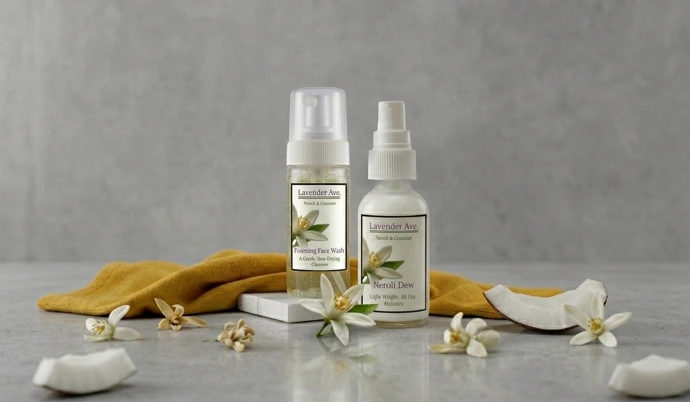
Take our new Neroli Foaming Face Wash. We replaced harsh sulfates with Coconut Water—a "liquid endosperm" rich in potassium and magnesium. Instead of synthetic "slip" agents, we use Hydrolyzed Oat Protein to provide a velvet-soft finish that actually repairs the skin’s barrier while you cleanse.
27 Years of Purity
Choosing natural skincare isn't just a trend; it's a long-term investment in your biological health. When you remove the synthetic noise, you allow your skin to do what it does best: heal, renew, and glow.Start writing here...